Who we serve
Clients and vendors

Ask once. Know it is covered.

Contractors, event organizers, utilities, film productions, and venues need officers on site and should not have to chase an inbox to find out if they are coming. One Bridge 10-8 gives the agency's clients one place to request, track, change, and settle paid duty — and gives the agency a clean record from the first ask.

At a downtown road construction site, a site superintendent in a hard hat checks a confirmation on her tablet as a paid-duty constable in a high-visibility vest arrives with a coffee.
1place to request, track, change, and settle paid duty
0"did you get my email?" calls to the coordinator
Up frontestimate attached to the request before it is approved
Matchedinvoice drawn from what was actually worked on the record
The client's problem

You need officers on site. You should not need a phone tree to get them.

Asking

The request is an email, and the email is never complete

You send the dates; they ask for the address. You send the address; they ask how many. The permit deadline does not move while you go back and forth.


Waiting

Confirmed means someone said so on the phone

You do not know if the duty is staffed until the morning of, and the crew, the permit office, and your client are all asking you.

Changing

A change restarts the whole conversation

Rain moves the pour a day. Now the request, the officers, and the bill are all out of sync, and you are the one reconciling them.

Paying

The invoice arrives weeks later and does not match

Hours, cancellation charges, and minimums appear that nobody explained, and disputing them means digging through a month of email.

What clients see

Request, track, settle — on one record

The three moments where paid duty goes wrong for a client today, and what each looks like when the request, the assignments, and the invoice are the same thread.

A utility crew supervisor at a cluttered field-office desk fills in a paid-duty request form on a laptop, a work order and coffee beside him
Request

Ask once, in a form that already knows what the agency needs

A lane closure, a festival, a film shoot, a utility dig, a school event. Today that request is an email that comes back with three questions. In 10-8 the client fills a structured request — location, dates and hours, how many officers, site contact, special instructions — and the estimate is attached before anyone approves it. No back-and-forth, no surprise on the invoice.

  • Location, hours, staffing, and contact captured in one pass
  • Estimate shown up front, from the agency's rate card
  • Save and reuse recurring requests instead of starting over
How paid duty works
A constable in a high-visibility vest directs traffic at a downtown construction site lane closure while a second officer checks a phone beside the foreman
Track

Know it is covered before the crew shows up

Received, approved, staffed, confirmed: the request moves through visible states, and the client sees each one without calling the coordinator. When officers are assigned, the client knows who to expect and when. Changes on either side update the same record, so the site and the agency are always reading the same page.
  • Status visible from submitted to confirmed to completed
  • Assigned officers and report times shown as your agency configures
  • Change a date or add an officer without restarting the conversation
Explore One Bridge 10-8
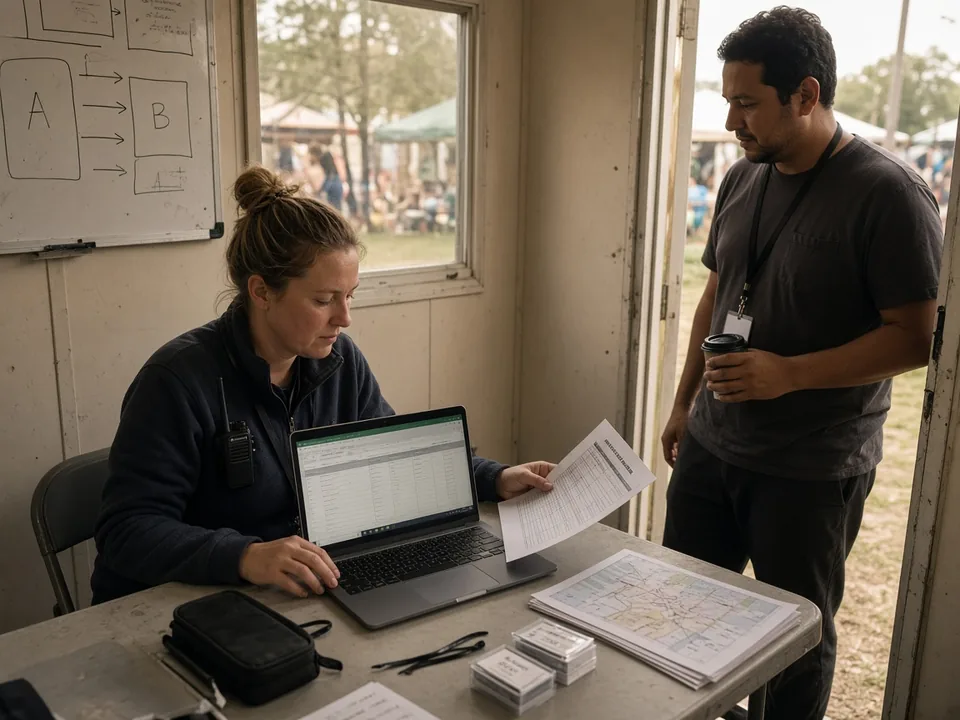
An event operations manager in a festival production trailer compares an invoice summary on her laptop against a printed schedule while a colleague leans in the doorway
Settle

An invoice that matches what happened on site

The invoice is drawn from the record — hours actually worked, changes, cancellations, minimum-hour and administration terms — because it lives on the same thread as the request and the assignments. The client can see the line items against the request they made, and a dispute is a look at the log, not a month of email.

  • Line items tied to the request and the shifts that were worked
  • Cancellation and minimum-hour terms applied the same way every time
  • History of every request and invoice in one client account
Estimates, billing, and terms
Why it works for the agency too

A better client experience is a cleaner agency record.

The client portal is not a bolt-on. It is the front door of the same One Bridge 10-8 record the coordinator staffs from, the chief reports from, and finance invoices from — so every request a client enters is one the agency does not have to re-key, chase, or reconstruct.

Intake

Complete requests, entered once

The structured form asks the client for what the coordinator needs, so requests arrive ready to staff. Phone requests are entered into the same form and become the same record.

Staffing

Officers who are qualified for the site

Because 10-8 reads credentials and work rules from 1 Bridge Tec HRIS, the officers offered a traffic duty or a licensed event are the ones eligible to work it.

Billing

Rate cards and terms applied from the record

Client types, rates, minimum hours, cancellation windows, and administration fees are configured once, and the invoice applies them from what actually happened.

Accountability

One answer for the client, the member, and finance

When anyone asks what was worked, who was there, and what changed, the log is the answer, visible to the people entitled to see it.

AI assistance, inside the agency's building

Faster answers for clients, without their data leaving the agency

With Private AI, the coordinator handling a client request gets help with the routine — on hardware installed at the agency, with nothing about a client, a site, or a shift sent to a third-party AI service.

Estimates

“What will a two-officer, ten-hour lane closure cost this client?”

The estimate from the client's rate card, with minimums and administration terms cited, ready to attach to the request.

Correspondence

Draft the confirmation and the change notice

Client messages drafted from the request record in the agency's voice, so a change reaches the site contact in minutes.

Terms

“What does this client owe if they cancel tonight?”

The cancellation clause quoted from the client's agreement, so the client and the coordinator hear the same answer.

See it working

Walk through a request from your biggest client.

Bring a real one — the multi-day event, the utility contract, the film shoot that changed twice. We will enter it as the client would, staff it as the coordinator would, and show you the invoice at the end, in about twenty minutes.

Book a Demo Paid-duty management See the same request from the coordinator's and the officer's side.
Common questions

Questions clients and agencies ask

Do our clients need to create an account?
Regular clients — contractors, utilities, venues, event organizers — get an account so they can see their history, reuse requests, and track status. A one-off client can be entered by the coordinator in the same form; it becomes the same record either way.
Can a client see which officers are assigned?
The agency decides. Typically a client sees that positions are confirmed and who to expect on site with a report time. Personal information about members stays inside the agency's system.
What happens when a client changes or cancels?
The change is made on the request, the assigned officers are notified, and the cancellation and minimum-hour terms from the client's agreement are applied automatically. The client sees the effect on the estimate before confirming.
Can we bill different clients on different terms?
Yes. Client types — municipal, commercial, film, event, utility — carry their own rate cards, minimums, cancellation windows, and administration fees, configured during implementation.
Does the client portal work on a phone?
Yes. Clients can request, track, and approve from a phone or tablet on site, which is where most of them are when the plan changes.

One request. One record. One invoice that matches.

See the client experience in a twenty-minute walkthrough with one of your real requests.