Reach
Postings go where candidates are not
General job boards attract volume, not fit. Agency careers pages are hard to find and harder to apply through on a phone.


Police services compete for the same people as every other employer, then ask them to wait months. 1 Bridge Tec HRIS shortens the path from posting to offer — mobile applications, sworn and civilian pipelines, on-site AI screening, and a candidate who always knows where they stand — without giving up the rigour the badge demands.
General job boards attract volume, not fit. Agency careers pages are hard to find and harder to apply through on a phone.
Recruiters read every application by hand, so qualified people wait behind unqualified ones.
Candidates hear nothing for weeks and accept other offers before the first interview is scheduled.
Leaders cannot see time-to-hire, drop-off points, or which sources produce sworn members.
Three places recruiting breaks, and what changes when the careers site, the pipeline, and the candidate's status all live on the same employee record.

Most people who would make good officers are not browsing a police website at their desk. They find the posting on a phone after a shift somewhere else. A branded, mobile-first careers site and one application per role mean the moment of interest becomes an application, not a bookmark.

Sworn hiring is not one interview. It is minimum requirements, written and fitness testing, panel interviews, psychological assessment, background investigation, and clearance — each with its own owner and its own outcome. Applicant Tracking models every stage, so a background unit and an interview panel work the same record.
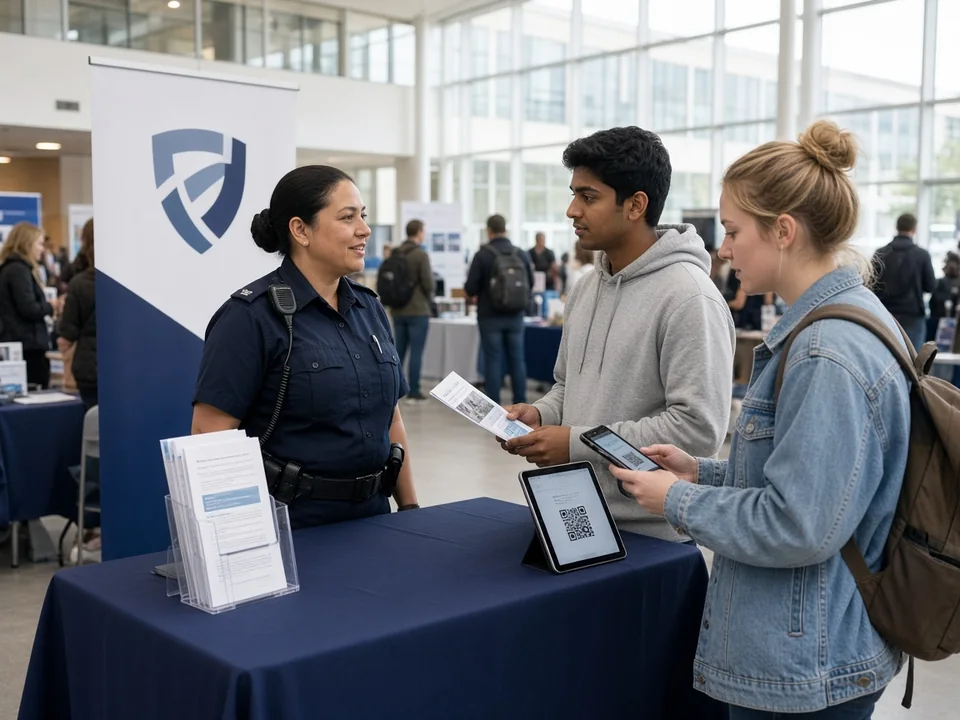
The candidate who accepts another offer usually did not fail a stage. They stopped hearing from you. Every stage change sends a status the candidate can see, recruiters see who is waiting on whom, and the booth conversation at a career fair becomes a record the same afternoon.
Each stage has an owner, an outcome, and a message to the candidate. Applicant Tracking ships with a sworn pipeline like this one and a shorter civilian pipeline, both configurable to your service.
Minimum requirements checked at submission, so nobody waits weeks to learn they were never eligible.
Written and fitness testing scheduled and scored in the pipeline.
Structured interview scoring recorded per panellist.
Psychological and medical assessments tracked with results held under restricted access.
The background unit works its own queue on the same record, with its own permissions.
Conditional and final offers issued, accepted, and dated from the pipeline.
The accepted candidate becomes an onboarding checklist and, on day one, a member 10-8 can staff.
With Private AI, recruiting help runs on hardware installed at the agency. No applicant's résumé, background notes, or assessment result is sent to a third-party AI service — and a recruiter or panel makes every decision.
Every applicant scored on the requirements of the role, with the reasons shown, so a panel can agree, disagree, and override.
Job descriptions and postings drafted from your existing roles, policies, and past postings, ready for a recruiter to edit.
Recruiters ask how a requirement or a policy applies and get the relevant passage with a citation, not a guess.
We post a role, apply from a phone, score the application, run it through a panel and a background queue, issue the offer, and show the moment it becomes an onboarding checklist. Bring your own job description and we will use it.
Screening, scheduling, and status updates run in the workflow.
Interview panels and background units work from the same record with their own permissions.
Pipeline analytics show where candidates stall and which sources produce members who stay.
A candidate who accepts becomes a member 10-8 can staff. Credentials verified during hiring travel with the record, so the first paid duty or overtime offer already knows what the person is qualified to do.
See how 1 Bridge Tec HRIS recruits for sworn and civilian roles, with the team that builds it.